
Sitemap
A list of all the posts and pages found on the site. For you robots out there is an XML version available for digesting as well.
Pages
Posts
Blog Post number 1
Published:
This is a sample blog post. Lorem ipsum I can’t remember the rest of lorem ipsum and don’t have an internet connection right now. Testing testing testing this blog post. Blog posts are cool.
portfolio
Portfolio item number 1
Short description of portfolio item number 1
Portfolio item number 2
Short description of portfolio item number 2
publications
Coulomb flux tube on the lattice
Published in Physical Review D, 2017
Here we utilized numerical Monte Carlo simulation to demonstrate the presence of a flux tube between static charges in the instantaneous Coulomb potential in Coulomb gauge for SU(2) lattice gauge theory. 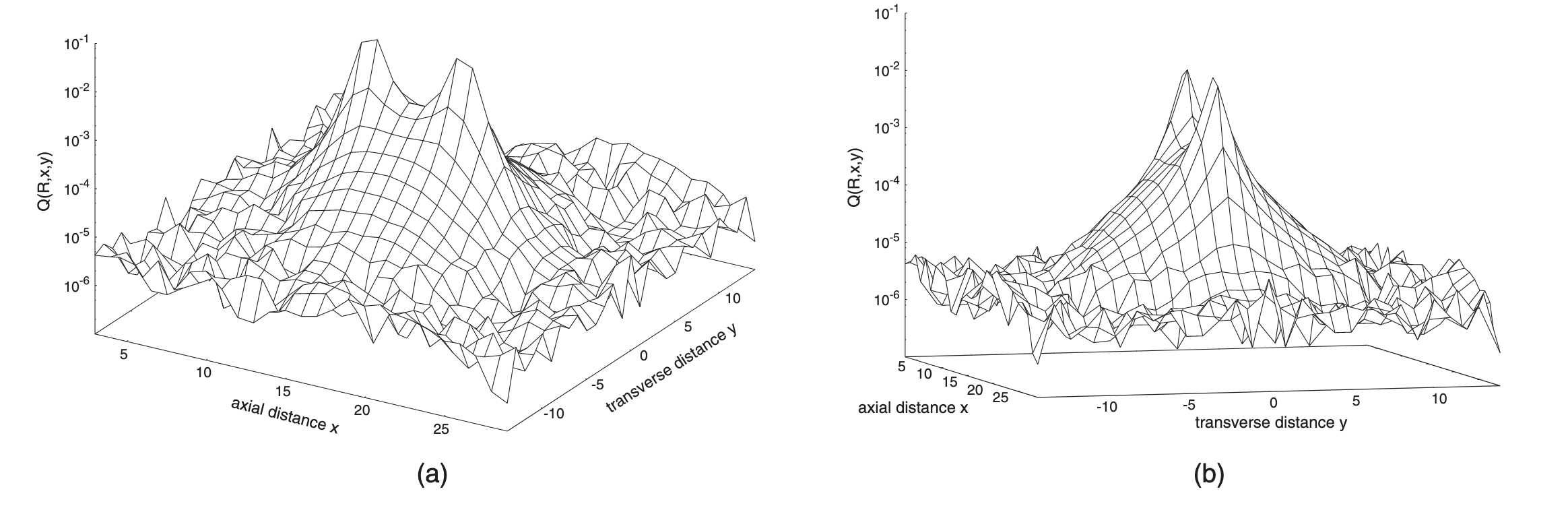
Probing Flat Band Physics in Spin Ice Systems via Polarized Neutron Scattering
Published in Physical Review Letters, 2022
In this work we studied the use of polarized neutron scattering to expose the correlations of flat band modes in a frustrated magnet. In particular we explained the “flat NSF”, i.e. the featureless non-spin-flip scattering cross section, of nearest-neighbor spin ice, and demonstrated how it attains features in dipolar spin ice. 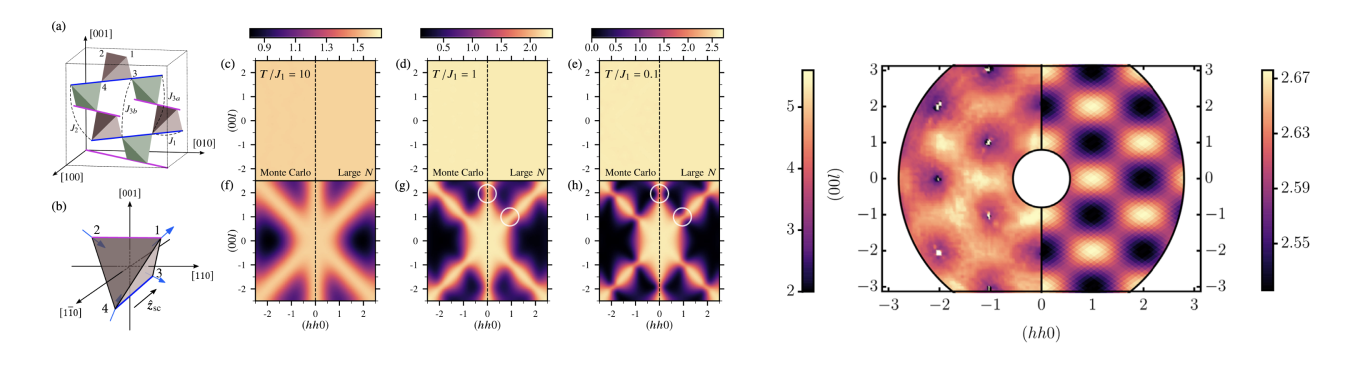
Mapping the Phase Diagram of a Frustrated Magnet: Degeneracies, Flat Bands, and Canting Cycles on the Pyrochlore Lattice
Published in (arXiv:2411.03429, in review), 2024
In this paper I have mapped in detail the phase diagram of pseudo-spin-1/2 pyrochlore magnets including all symmetry-allowed nearest-neighbor anisotropic interactions. I show how to organize spins into multipole moments, whose components correspond to different irreducible representations (irreps) of the lattice point group, each corresponding to a different ground state. I then demonstrate how to invert the couplings in order to comprehensively explore all ways that the different irreps can be made degenerate, which allows me to draw a clear picture of the phase diagram and explore a variety of interesting features in it, including a special locus about which families of Hamiltonians have a non-trivial winding number. 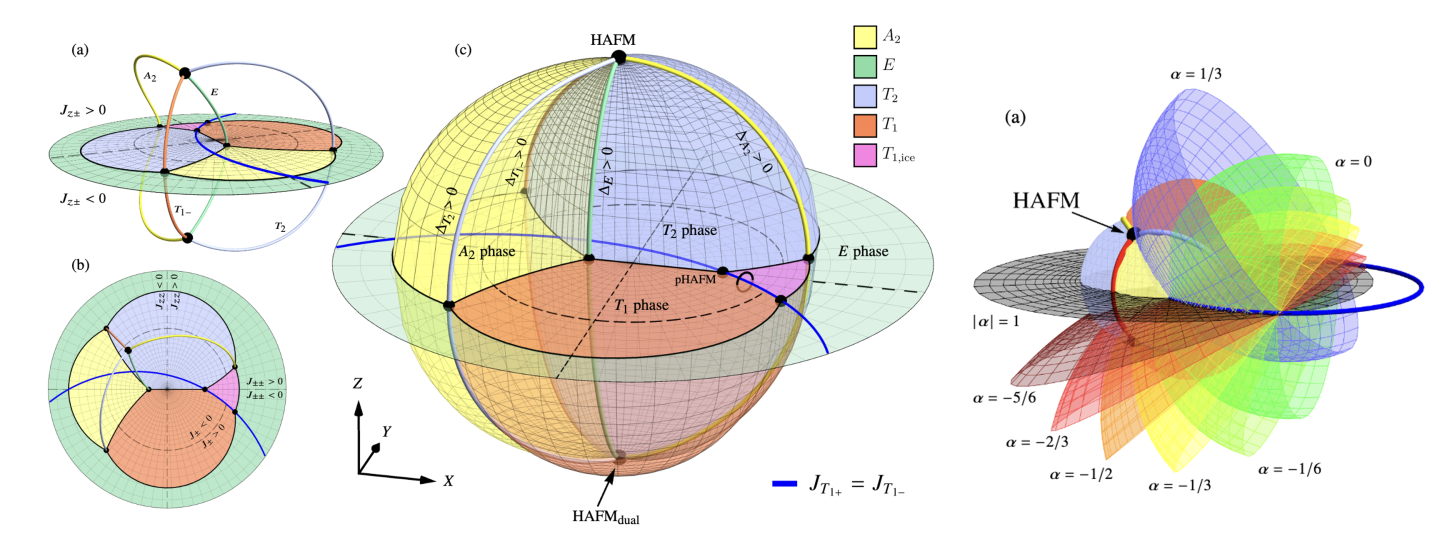
2-Form U(1) Spin Liquids: A Classical Model and Quantum Aspects
Published in Physical Review B 111, 064417 (2025), 2025
In this work I introduce a novel class of 3D spin liquids called 2-form U(1) spin liquids. These are described by emergent 2-form U(1) gauge fields, whose charged excitations are strings rather than particles. We construct an Ising model on the pyrochlore lattice which realizes the classical version of this spin liquid and discuss how to perturbatively map transverse exchange terms to a 2-form U(1) lattice gauge theory, potentially realizing a quantum 2-form U(1) spin liquid. This gauge theory suffers from a confinement instability due to magnetic instantons, the same mechanism that destabilizes 1-form U(1) gauge theory in 2D (the Polyakov mechanism), and we discuss some interesting directions this might lead in, such as a generalization of the Dirac spin liquid (2D U(1) gauge theory plus fermions) to 3D. 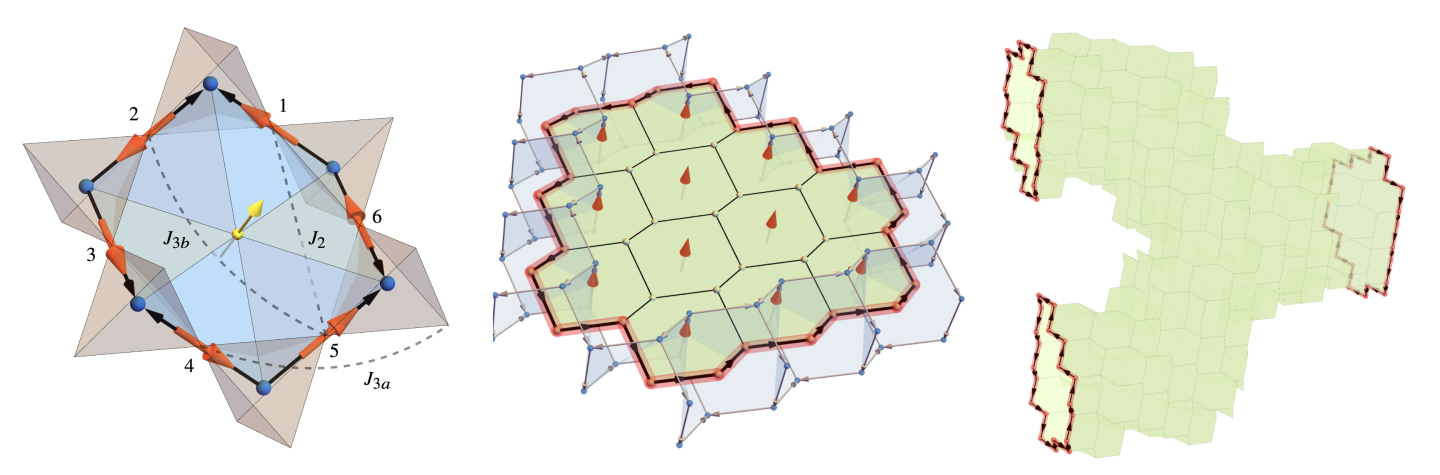
Geometrically Frustrated Quadrupoles on the Pyrochlore Lattice and Generalized Spin Liquids
Published in (arXiv, in review), 2025
In this paper we explore the physics of geometrically frustrated quadrupoles on the pyrochlore lattice. This may be viewed as a generalization of the dipoles, \(L=1\) angular momenta, to \(L=2\) angular momenta degrees of freedom. Whereas dipoles have three degrees of freedom, quadrupoles have five. Using the same methods as in my work on the dipole model phase diagram, we construct the most general symmetry-allowed nearest-neighbor Hamiltonian, which has nine allowed couplings, and map out in broad strokes the structure of the phase diagram. Importantly, it looks similar to the the dipolar phase diagram, but all of the easy-plane degree of freedom and phases are doubled. It turns out that quadrupoles behave in surprising ways which depend strongly on the spin quantum number, because the quadrupolar \(3z^2 - r^2\) operators is not unitarily related to the other four, which we discuss at length. We explore order-by-disorder in this model and construct some examples of quadrupolar spin liquids. Most interestingly, we construct a rank-3 tensor spin liquid which exhibits 6-fold pinch points, by exploiting intuition gained from a multipole decomposition. We discuss the relevance of this model to frustrated magnetic materials, especially those with non-Kramers crystal field doublets or low-lying excited doublets like Tb\(_2\)Ti\(_2\)O\(_7\). 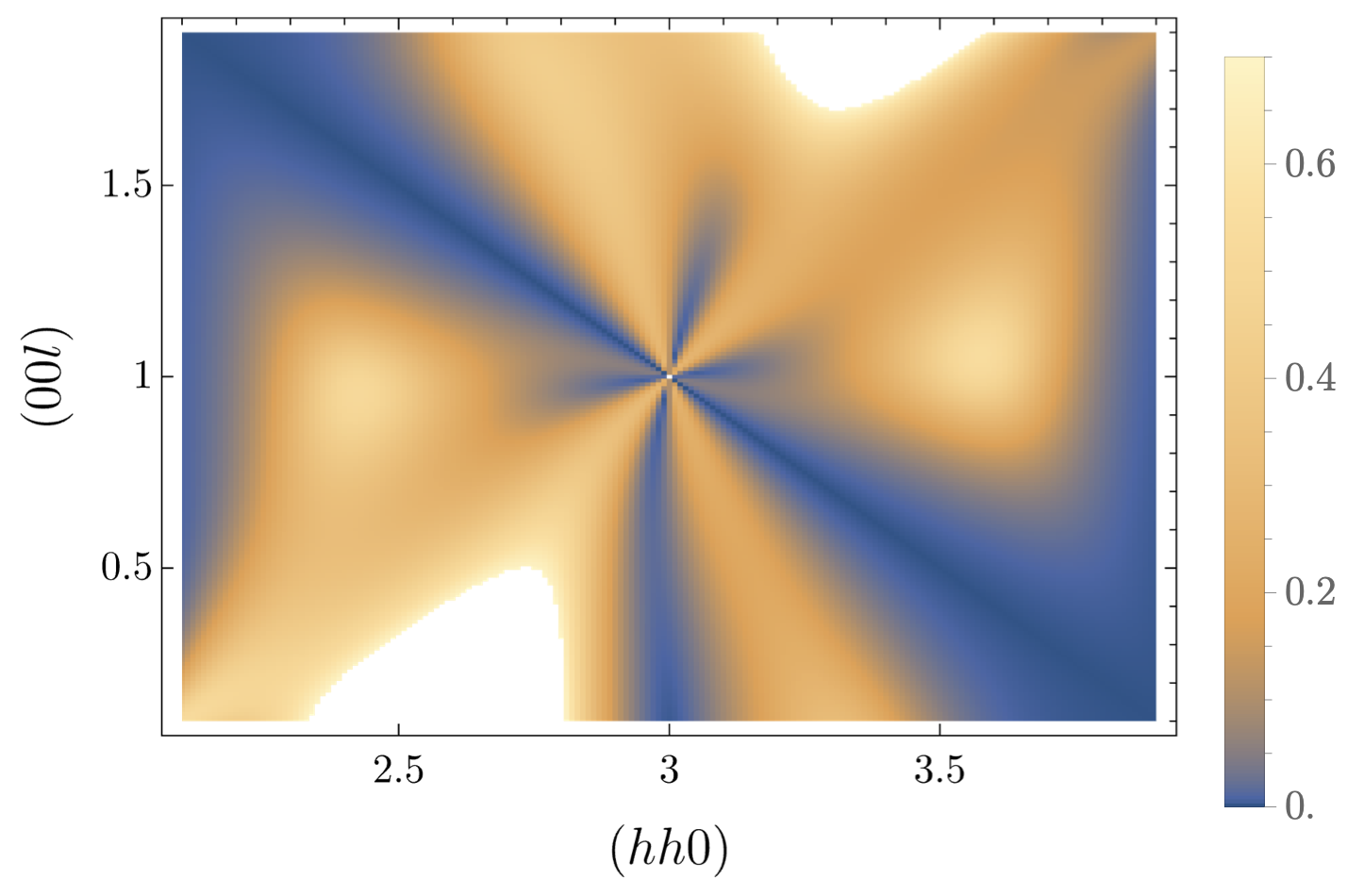
Spontaneously Broken Non-Invertible Symmetries in Transverse-Field Ising Qudit Chains
Published in (arXiv:2508.11003, in review), 2025
In this work we explore the basic properties of spontaneously broken non-invertible symmetries in a simple 1D chain model which generalizes the transverse-field Ising model. The Ising model has a $Z_2$ symmetry which is spontaneosuly broken, and is easily generalized to a clock model with $Z_N$ symmetry. These are further generalizable to qudit models with $G$ symmetry for an arbitrary discrete group $G$. Whereas the Ising and clock models are Kramers-Wannier self-dual, the analogous dual model for a non-Abelian group $G$ does not have $G$ symmetry but instead has non-invertible Rep($G$) symmetry. We study the Rep(G)-symmetric transverse field model and the spontaneously broken phase with a combination of exact analytical solutions at zero transverse field and DMRG numerical calculations. The most unique feature of the Rep(G)-broken phase is that different ground states have inequivalent entanglment patterns. Each ground state is labeled by an irrep of G, and has exact entanglement spectrum degeneracies equal to the dimension of the irrep. Thus the Rep(G) SSB blends local and non-local orders, which we show by computing both local and string order parameters. We show that the domain wall quasiparticles carry internal degrees of freedom and satisfy fusion rules like non-Abelian anyons in one higher dimension.
Higgs Phases and Boundary Criticality
Published in SciPost Physics, 2025
For half a century now there has been a rich ongoing debate as to whether Higgs and confined phases of gauge theories are the same or distinct phases. A famous 1980 proof by Fradkin and Shenker demonstrates they are thermodynamically the same bulk phase, but they remain separated by a first order line with a critical endpoint, very similar to the liquid-water phase boundary. In this analogy the Higgs phase is the liquid phase and the confined phase is the gas. They exhibit phenomenologically distinct properties despite only being separated by a supercritical region. In this work we have explored the distinction of Higgs and confinement with open boundaries through a combination of analytic arguments and numerical simulations. We show that the Higgs regime of the phase diagram exhibits boundary symmetry breaking, while the confined regime does not. We demonstrate that this is a ubiquitous phenomenon in Higgs models whether the gauge group be Abelian or non-Abelian, and whether the gauge field is 1-form or higher-form. 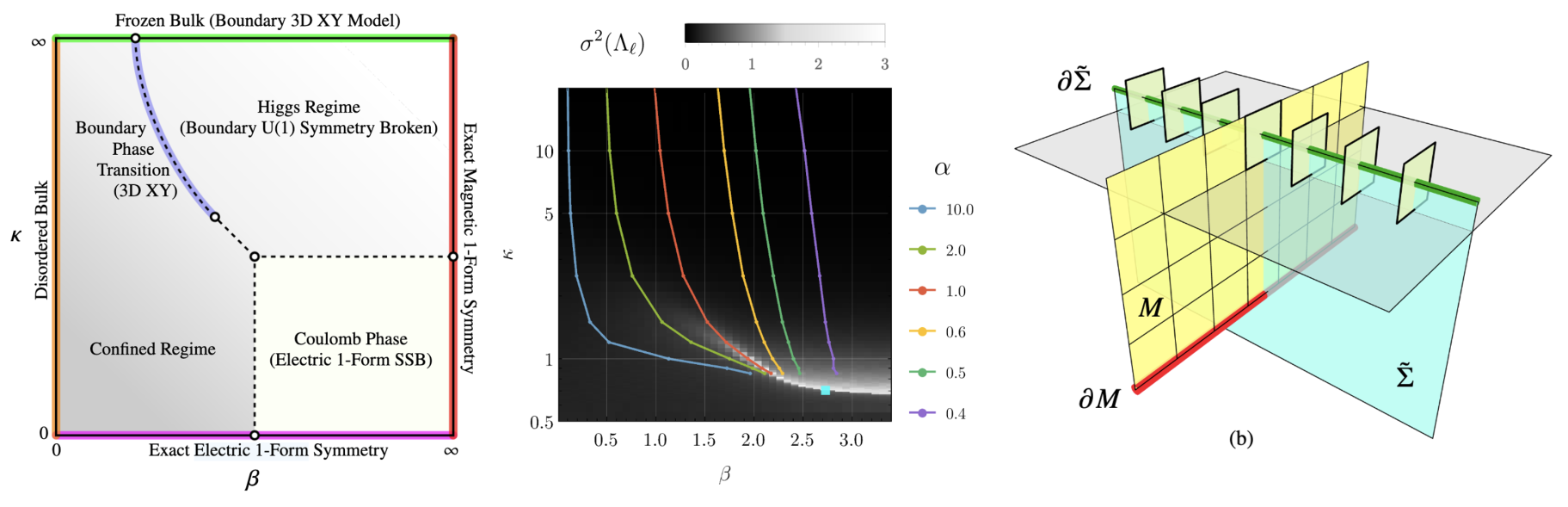
talks
POSTER: 2-Form U(1) Spin Liquids: Classical Model and Quantum Aspects
Published:
This poster won the best poster award! 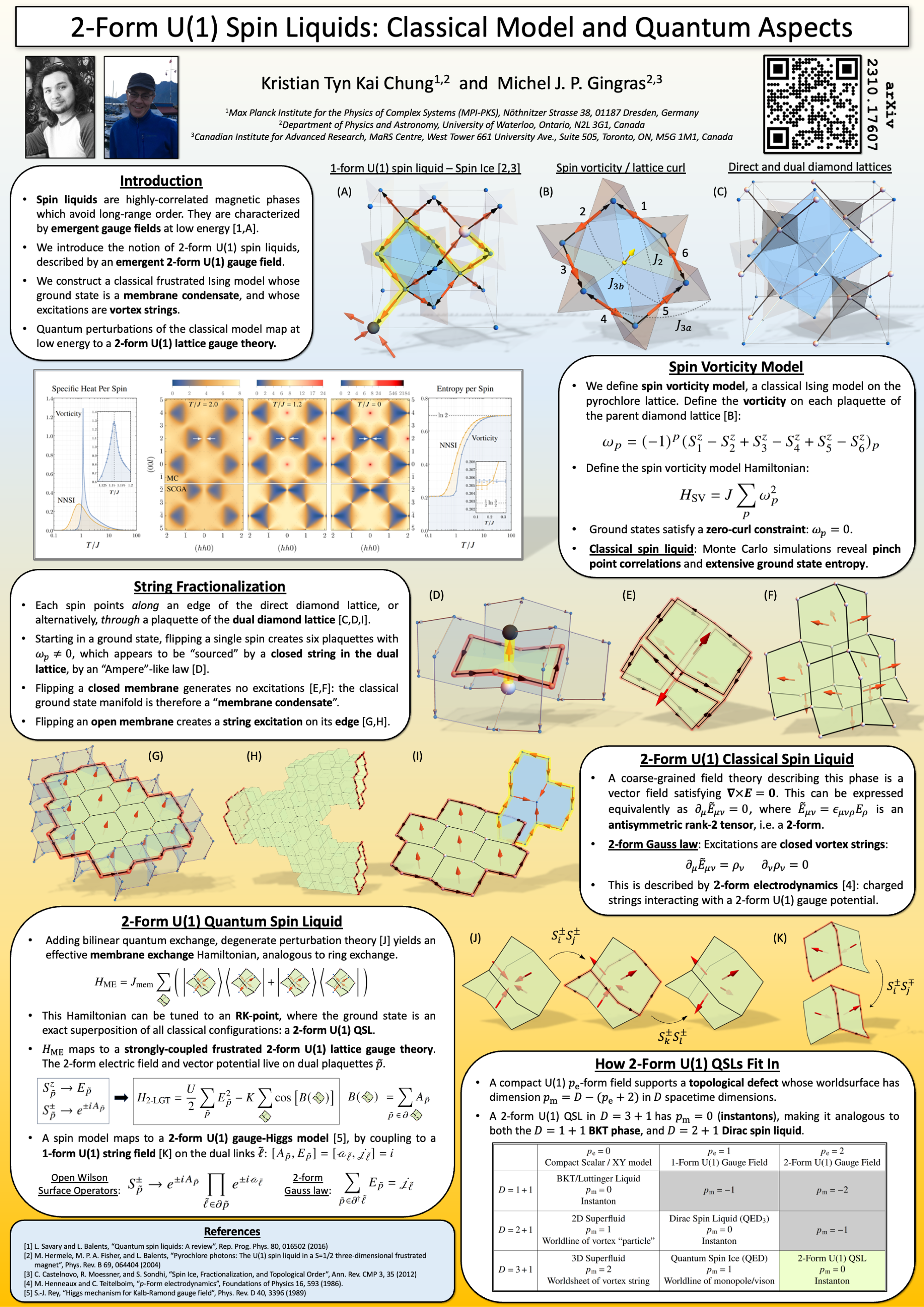
TUTORIAL: A Gentle Introduction to Generalized Symmetries
Published:
This 2-part talk was given as part of the “Condensed Matter for Dummies” series hosted at MPI-PKS. You can watch this talk on YouTube here (Part 2 in video description).
teaching
Teaching experience 1
Undergraduate course, University 1, Department, 2014
This is a description of a teaching experience. You can use markdown like any other post.
Teaching experience 2
Workshop, University 1, Department, 2015
This is a description of a teaching experience. You can use markdown like any other post.